
// BUYER’S GUIDE
Tamper-Proof Fasteners: Where They Make Sense
If anyone can reach a screw with a common driver, ask whether anyone should be able to remove it. For public fixtures and exposed equipment panels, tamper resistance deserves a place on the drawing from the start.
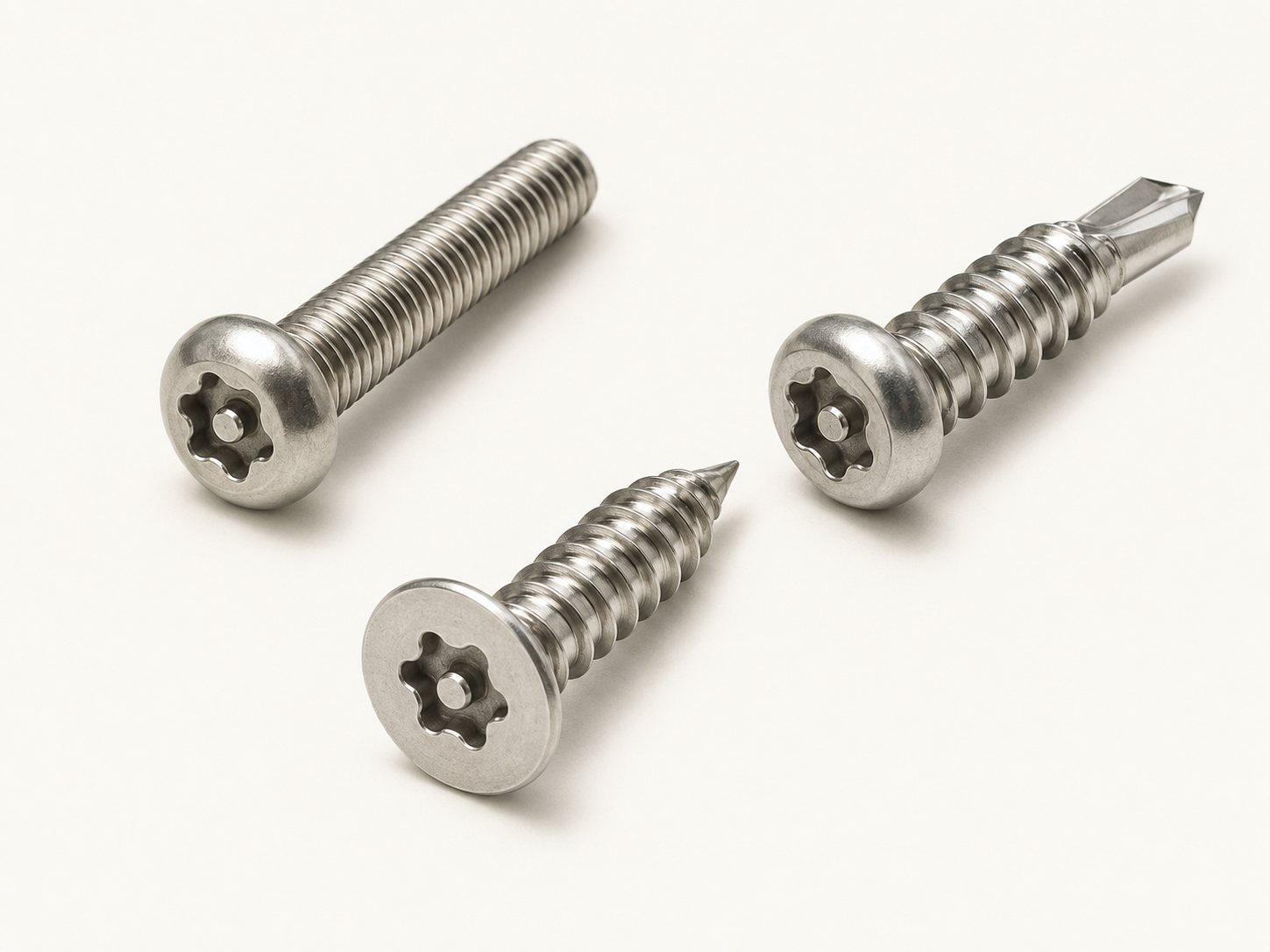
Specify tamper resistance more often
A public restroom partition and an equipment access panel can both benefit from security screws. The difference shows up when someone needs to take them apart. A technician may open the panel several times a year, while a partition bracket may stay in place until the next renovation.
For publicly accessible fixtures, display hardware, and exposed equipment covers that only staff should open, make tamper resistance a standard question on every new job. When you’ve already identified who should have access, a security drive can put that decision into the hardware. Review existing installations when you’re replacing a fixture or updating a standard parts list.
“Tamper-proof” is a common term for this hardware. Tamper-resistant describes what it does: deters casual removal, often by requiring a dedicated tool. Combine that deterrent with whatever access controls the installation requires. See the Security Drive Guide.
Choose the drive around the service plan
When technicians need access
Pin-in six-lobe and pin-in hex drives use a compatible hollow-tip tool. Two-hole spanner screws take a matching two-pin driver. Tri-Groove screws and nuts take an external socket, so check that there’s clearance around the head or nut.
When routine removal is unlikely
Consider one-way screws or break-away nuts. The one-way drive resists ordinary reverse engagement, and a break-away nut sheds its installation section as it tightens. Plan how the crew would replace a damaged fixture before choosing either. Compare the drive options.
Check the whole joint before you order
Look at the assembly from both sides. If the nut is exposed, a security drive on the screw head may leave the other side of the joint accessible. If the fastener sits in a recess or near a wall, verify that the tool can reach it and seat properly. For outdoor installations, choose the material and finish for the environment and mating materials separately from the drive.
Walk through the job with the person who will service it. For example, on a retail display with a removable panel, ask whether staff need to open it between shifts and where they’ll keep the driver. Build those details into the order before it goes out.
For repeat jobs, put the fastener and its matching tool on the purchasing list. Record both part numbers in the service instructions and decide who will keep spare tools. A clear service plan makes it easier to specify security hardware on the next job, too.
Give your supplier enough to quote the job
- Hardware. Send the application, quantity, thread and length, head style, material and finish, plus any drawings or specifications.
- Access. Explain who needs to remove the fastener, how often, and whether the tool has to reach into a tight space.
- Tooling. Ask for matching bits, drivers, or sockets. For a replacement, include a photo of the existing drive and any dimensions you know.
Confirm specifications, installation requirements, and suitability with the manufacturer or your engineer before ordering.
Bring Screw & Supply the whole inquiry
Screw & Supply stocks security fasteners and the tools that go with them. When your customer needs a configuration outside the catalog, send the print for a custom sourcing review. See our security product range.
Give us a chance to quote your next security job. Send a single part or the full job list and ask us to quote the matching tooling alongside the hardware.